
After the first session, a new client asks whether the fee could be a little lower – she’s a student and works part-time on the side. A client who has been coming to you for three years still pays your 2023 rate, while your rent and your supervision have both gone up. And you have the feeling you’ll never work out how much to charge for therapy sessions properly – you just keep adjusting the numbers in your head.
The short answer: take the monthly revenue you need (your own pay, tax and social contributions, costs and a reserve) and divide it by the number of sessions that will actually take place and get paid. Give discounts only under a rule you set in advance, with an end date, and write them down. An exception without a rule turns into a price nobody ever recalculates.
Below you’ll find practical tips for setting your fees, the situations therapists most often run into, wording for messages to clients, and how to keep track of different rates.
What goes into the price of one session?
The fee has to cover more than the time with the client (usually 50 minutes). It also pays for everything around that time that you don’t bill separately. The Czech site Mentoring psychoterapie breaks it down in a similar way.
- Work around the session: preparation, notes, reflection, admin and invoicing.
- Professional development: supervision, training, further education, membership of a professional association.
- Running costs: room rent, equipment, software for managing sessions and clients, phone, insurance, accountant.
- Time without income: holidays, public holidays, sick days, seasonal dips and cancelled sessions.
- Tax and contributions: income tax advances, social and health insurance.
- A financial reserve: for slower months, development and gaps in income.
A reserve isn’t at odds with the ethics of a helping profession. It lets you keep a sustainable caseload, keep learning and keep working through a drop in income – which also protects continuity of care for your clients.
How to calculate your session fee, step by step
Your fee is the monthly revenue you need divided by the number of sessions that actually happen and get paid in a month. Six steps:
- Decide how much you want to take home each month after tax.
- Add tax and social contributions. Under a flat-rate regime this is a fixed monthly amount; otherwise use your effective rate from last year’s tax return.
- Add your monthly costs, including yearly expenses divided by twelve (training, for example).
- Add a monthly reserve for holidays, illness and slower months.
- Estimate the number of sessions: client hours per week times working weeks per year, divided by twelve, minus sessions cancelled without payment.
- Divide the revenue you need by the number of sessions.
Worked example: Jana, a therapist with 18 client hours a week
Jana practises in the Czech Republic, so the figures are in Czech crowns (CZK) and her tax follows Czech rules. The method is the same anywhere – put in your own currency, costs and tax. The numbers are illustrative; your fee will come out differently.
- Net monthly income: CZK 45,000
- Tax and contributions: CZK 16,745. Jana is in the Czech flat-rate tax regime (paušální daň), band 2, which applies to annual income between CZK 1 and 1.5 million. Her annual revenue comes to roughly CZK 1.02 million. The monthly amount for 2026 is published on Businessinfo.cz.
- Costs: CZK 16,500 (room rent 7,000, training 3,000, supervision 2,000, software and phone 2,000, memberships and insurance 1,500, accountant 1,000)
- Reserve: CZK 5,000
- Revenue needed: CZK 83,245 a month
Jana plans for 18 client hours a week and 44 working weeks a year (the rest is holidays, public holidays, illness and training). That’s 66 sessions a month. Around 8% are cancelled without payment, so roughly 61 get paid.
The fee per session comes out at 83,245 ÷ 61 = about CZK 1,365, rounded up to CZK 1,400. At that fee her monthly revenue is CZK 85,400 – about CZK 2,150 more than she needs.
The same calculation with different hours: at 15 hours a week (about 51 sessions a month) the fee comes to around CZK 1,630; at 22 hours (about 74 sessions) to around CZK 1,125. The number of sessions moves the fee by hundreds of crowns. More client hours don’t necessarily mean a healthier practice, though – plan them around what you can sustain long-term and the quality of care you want to give.
How many sessions to count, and how to allow for gaps
Be conservative: there are fewer than 52 working weeks in a year, and not every booked session takes place.
From the example above: 52 weeks, minus 4 weeks’ holiday, minus public holidays, minus weeks of illness and training, leaves about 44 working weeks. Allow for:
- holidays and public holidays,
- training, supervision days and conferences,
- illness,
- seasonal dips, such as quieter summer months,
- cancelled sessions you don’t get paid for.
If you’ve been in practice for more than a year, use your actual figures from the last 12 months. If you’re just starting, make a cautious estimate and compare it with reality after six months.
How to compare your fees with colleagues’
Colleagues’ fees are a guide, not a target: someone with different training, rent and capacity has different costs. Combine the comparison with your own calculation.
- Find 5 to 8 price lists from colleagues in the same city or working online, with comparable training and experience.
- Note the session length, the fee, whether it’s online or in person, and whether they offer reduced rates.
- Compare them with your own calculation and explain the difference to yourself: capacity, location, specialisation, experience.
A general average from the internet tells you little about your practice, because it ignores location, training and the format of the sessions. What counts is the comparison with colleagues who work the way you do.
What should your therapy session pricing include?
Your price list should show the types and lengths of sessions, the fee for each, and the payment terms. An example at CZK 1,400 for 50 minutes (a rule of CZK 28 per minute):
- Individual session, 50 minutes: CZK 1,400
- Initial consultation, 60 minutes: CZK 1,700
- Short consultation, 25 minutes: CZK 750 (a little more than half, because the admin stays the same)
- Couples therapy, 75 minutes: CZK 2,100
The price list should also say how and when clients pay (in advance, on the day, by bank transfer or QR code), how cancellations work and when the prices take effect. Agree the fee and payment terms before the first session and have them in writing.
One fee for online and in-person sessions is easier for clients to understand. Two fees make sense if your costs differ a lot – room rent, for example.
When and how to raise your rates
Raise your fees regularly, in reasonable steps and with notice. The usual reasons are rising costs (rent, supervision), finished training or a higher qualification, and a full caseload. How to go about it:
- Recalculate your fee using the steps above.
- Decide from which date the new fee applies to new clients, and from which date to existing ones.
- Announce the change in writing, in advance. We recommend at least four weeks.
- Keep it short and factual, with the date it takes effect and the reason.
- Keep sessions booked before that date at the old fee.
Example: Jana raises her fee from CZK 1,400 to CZK 1,600. At 61 sessions a month that’s CZK 12,200 more a month, CZK 146,400 a year – if every client accepts the change. Expect some clients to ask about it or change how often they come.
Message to existing clients – example:
Hello, from 1 January 2027 my session fee will change from CZK 1,200 to CZK 1,400. The reason is higher running costs and ongoing investment in supervision and training. Sessions booked until the end of December stay at the current fee. Thank you for your trust.
Message to new enquiries – example:
An individual session (50 minutes) is CZK 1,400. You can pay in advance by bank transfer or QR code.
When does a discount make sense, and when not?
A discount makes sense when it follows a rule you set in advance and can explain to any client. It doesn’t make sense as a response to pressure or awkward haggling.
The situations therapists face most often, and how to handle them:
A student or a client on a low income
Offer reduced rates with a limited number of places and a fixed review date – for example CZK 900 instead of 1,400 for three months. Two clients on a reduced rate at 4.3 sessions a month means 2 × 4.3 × CZK 500 = CZK 4,300 a month, roughly 5% of the revenue Jana needs.
A client who has lost their income
A temporary adjustment with an end date works better than an open-ended discount: say, two months at a lower rate, then a review together. The alternative is a change in frequency – a session every two weeks instead of every week – at the same fee.
A long-standing client on an old fee
A client has paid CZK 1,100 since 2023 and the new fee is CZK 1,400. A jump of CZK 300 is a 27% increase. A gradual step can work better: CZK 1,250 from January and CZK 1,400 from July – an increase of 14% and then 12%.
Couples therapy or longer sessions
Base the fee on time, not on the number of people. In the example price list, 75 minutes comes to CZK 2,100 (CZK 28 a minute). Only discount couples sessions if you’ve built that discount into your calculation.
A client asks for a discount in the very first session
Answer briefly, without apologising. For example: “My fees are the same for everyone. I have a limited number of reduced-rate places for students. Would you like me to check whether one is free at the moment?” If a discount isn’t possible under your rules, say so in one sentence and don’t over-explain.
How to set discount rules that don’t turn into chaos
Discount rules should be written down, limited and the same for every client in the same situation. Five steps help:
- Decide how many reduced-rate places you have – for example, no more than one or two sessions in ten.
- Set the criteria: studying, low income, a temporary situation. You don’t need to ask for proof, but you do need to be able to explain the criterion.
- Give every discount an end date or a review date.
- Record only what you need: the client, the rate, valid from and to. Don’t write down the reason in detail – a category is enough, such as “reduced rate until 31 March”.
- Communicate neutrally and briefly, in the same words to every client.
An ethical framework helps too. The code of ethics of the Czech Association for Psychotherapy (ČAP) asks psychotherapists to stay alert to financial pressures and to clarify in advance everything that may affect the work with a client. Fees and discount terms reasonably belong on that list. More on protecting clients is on the ČAP website.
A discount is a price, not a gift: the invoice and your records should always show the fee actually charged. Don’t put the reason for a discount on the invoice – it may end up with the client’s employer or accountant.
How Lumi helps with fees and discounts
Lumi is a practice management tool for therapists, so it ties the fee, the discount and the invoice to the actual session. You set up services with their own prices – an individual session and a short consultation, for example – and decide for each one whether it’s paid before or after the session. Every client can have their own discount and their own invoicing settings, so a reduced rate for a student doesn’t mean editing the price by hand.
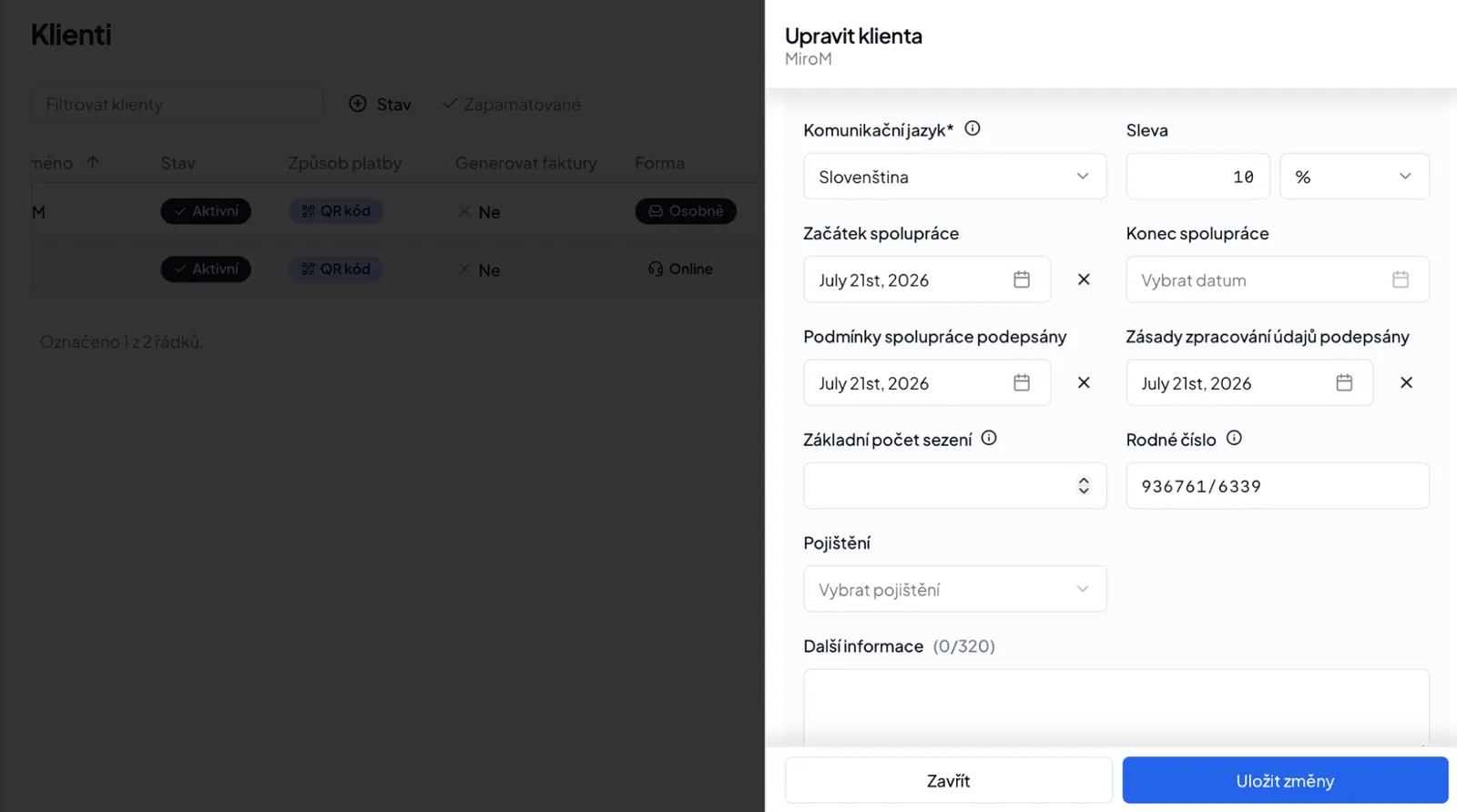
For payments and invoices, Lumi works like this: the client pays by bank transfer via a QR code with no transaction fee, Lumi matches the payment to the session automatically, and the invoice is issued and sent automatically. You can switch invoicing on or off for each client and for each session, so clients who don’t need an invoice don’t get one. If a payment is missing, the client can get a reminder 48 hours after the session, or you can send one with a single click.
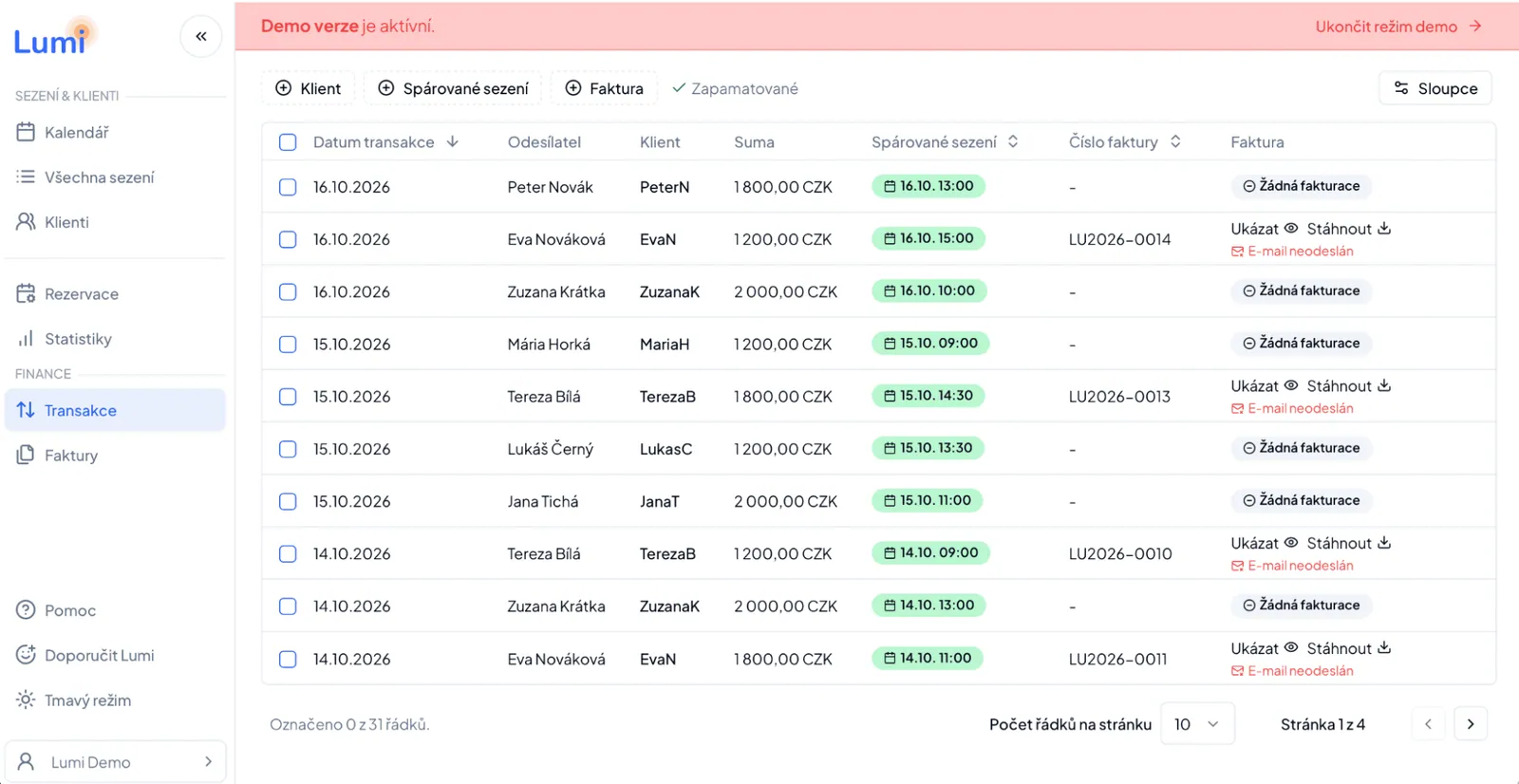
Beyond fees, payments and invoices, Lumi includes a calendar with session reminders, an online booking page, client records and session notes. Data is stored in the EU, encrypted in transit and at rest, and backed up regularly. Lumi is free for up to 10 sessions a month, EUR 29 a month for up to 25 sessions and EUR 49 a month with no limit, and every subscription starts with a free 14-day trial. Find out more about Lumi, or see how it compares with other tools. Or try Lumi free for 14 days right away.
The most common pricing mistakes
- The fee is set by gut feeling or by the lowest price on the market, and never recalculated.
- Holidays, illness and cancelled sessions are left out of the calculation.
- Discounts have no end date, so they become the new price.
- Different rates aren’t written down anywhere, and six months later nobody knows who pays what.
- A price change is announced in the session itself, or without notice.
- After years of no change, the fee jumps by a quarter or more in one go.
- The invoice shows a different price from the price list, with no explanation.
Summary
Work out your session fee from the monthly revenue you need and the number of paid sessions, planning capacity conservatively and allowing for holidays, illness and cancellations. Treat colleagues’ fees as a guide. Your price list shows session lengths, fees and payment terms. Raise your rates regularly, in writing and with notice. Give discounts under rules you set in advance, with an end date, written down – and always put the fee actually charged on the invoice. Keep track of different rates and discounts so you never have to edit them by hand.
If you want your services, fees, discounts, payments and invoices tied to each session, you can try Lumi free for 14 days.
Information on Czech tax and contributions is correct as of 8 October 2026.
Frequently asked questions
How much to charge for therapy sessions?
There’s no universal number – the fee follows from your costs, the income you need and the number of sessions. Divide the monthly revenue you need by the number of paid sessions. In the worked example with 18 client hours a week, the fee came to about CZK 1,365; yours will be different. The step-by-step calculation is above.
How often should I raise my fee, and how do I tell clients?
Recalculate regularly – once a year, for example – and raise the fee when the new calculation comes out higher. Announce the change in writing and in advance – we recommend at least four weeks – and give the date it takes effect. Sessions booked before that date can stay at the old fee. This is a recommendation from practice.
Should I give a discount to a client who asks for one?
It depends on whether they meet the rules you set in advance – a reduced rate for students, say, or a temporary discount after a loss of income. If you don’t have a rule yet, create one first, and only then decide about individual clients. A discount should have an end or review date and be written down.
What goes on the invoice for a reduced rate?
The fee actually charged and a description of the service: the type of session, the date and the length. Don’t put the reason for the discount or the client’s personal situation on the invoice – it may end up with their employer or accountant.